From Credit to Wallet: Where 92 TH/s Ends Up
A 92 TH/s machine settles 4.127e-05 BTC a day, which is $3.36 after the listed charge and $100.67 across a 30-day month. The credit appears in the mining account; the coin only becomes spendable or convertible when someone decides where it should go. That decision, made once, quietly shapes how much of the balance survives the year.

Key takeaways
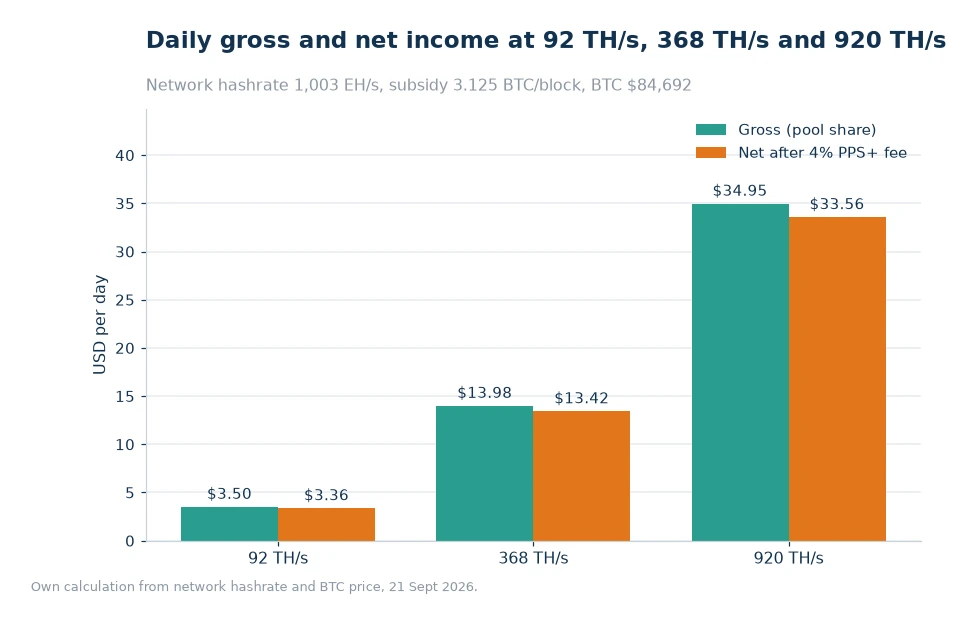
- 92 TH/s settles $3.36 a day, or $100.67 over 30 days, at $84,692 per BTC.
- The listed 4% costs $0.14 a day at this hashrate, about $4.20 a month.
- Mining withdrawals carry no fee, so moving credited coins out is not the expensive part of the pipeline.
- Leaving a balance idle and converting it later are different choices with different exposure.
The credit is not the coin in hand
A pool balance is a claim, not a coin. It sits in an account, it is denominated in a currency, and it can be moved, converted or held. Most miners never think about that distinction until they want to pay for something and discover that the balance is in the wrong place, on the wrong chain, or in the wrong asset.
The credit itself arrives with a deduction already applied. Under PPS+ the block-reward slice is settled hourly against current difficulty, and the listed 4% is taken from that slice; the transaction-fee slice is handled separately with a listed 2%. What lands in the account is therefore a net figure, and the balance grows by that net amount each hour rather than by the gross value of the shares. An account on ViaBTC Crypto Mining shows that growth as a running balance with a history, which makes it easy to check a month against the plan.
For 92 TH/s the difference is small in absolute terms, $0.14 a day, but the direction matters. A miner who plans around the gross number will always find the account a little short of the plan, and will spend time looking for an error that is actually a fee.
Hourly settling, occasional moving
Hourly settlement is a feature with a behavioural side effect. Because the balance updates 24 times a day, it invites daily attention, and daily attention invites daily decisions. Most of those decisions are noise. A miner who converts or withdraws every day pays spread and network fees far more often than someone who moves a month's output in one go.
The counter-argument is exposure. Holding a balance in the account is economically similar to holding the coin itself, so a miner who intends to sell eventually is taking price risk for as long as the balance sits there. That risk may be welcome or unwelcome, but it should be a choice rather than an oversight.
A workable middle ground is a threshold. Let the balance accumulate until it reaches a figure that justifies the friction, then move it in one action. The threshold is a personal number; what matters is that it exists before the first day the price moves sharply and the decision gets made in a hurry.
Three resting places for the same coin
The account, the conversion desk and an external address are the three places a mined coin can be. They are not equally good at everything, and the right mix depends on what the coin is for: paying a power bill, holding a position, or settling a purchase.
| Destination | What sits there | Fits when | Cost note |
|---|---|---|---|
| The mining account balance | Credited coins, ready to move | The next move is already planned | No fee to receive a mining payout |
| Auto Conversion into another asset | The converted currency | Spending or holding is planned in a different coin | Conversion pricing applies at the venue |
| An external address you control | Coins under your own keys | Long-term holding or paying a third party | Network fee on the send |
The first row is the default and is fine for a miner whose next action is already decided. The second suits someone who wants the value in another currency without a separate exchange account, and it removes a step that would otherwise be repeated monthly. The third is the only row that removes the counterparty, and it costs a network fee and a wait for confirmations.
The cost of moving too often
Frequent small withdrawals feel prudent because each one is small. In aggregate they are the most expensive way to operate, because the fixed part of a send does not shrink with the amount. A monthly move spreads that fixed cost over a month of credit; a daily move pays it thirty times for the same coins.
The same logic applies to conversion. Each conversion is a pricing event, and the spread between the quoted rate and the mid-market rate is paid on every one of them. A miner converting $3.36 daily pays that spread 365 times a year; a miner converting $100 once a month pays it twelve times, on a larger amount. If the spread is proportional the totals are similar, and if any part of it is fixed the frequent mover loses.
That is a small edge, and it compounds quietly over a year of operation.
There is a behavioural cost too. Daily decisions invite reaction to daily price moves, and reaction to daily price moves is how a holding plan becomes a trading habit. A threshold removes the decision from the moment and puts it in a rule, which is a better place for it. The rule can be changed, but only deliberately, and that is the whole benefit.
Worked example
Follow a month of 92 TH/s output through the account and out to a threshold-based withdrawal.
- Daily output: 92 × 0.00000044865 = 0.00004127 BTC, written 4.127e-05.
- Gross value: 0.00004127 × 84,692 = $3.50.
- Listed charge on the block-reward part: 3.50 × 0.04 = $0.14, leaving $3.36.
- Thirty days: 0.00004127 × 30 = 0.0012381 BTC, or $104.86 gross and $100.67 settled.
- Fee fraction of the month: $4.20 out of $104.86, about 4.0% of the block-reward-derived value.
- A 0.001 BTC threshold is crossed after roughly 24.2 days at this rate, so a miner using that threshold moves once a month rather than 30 times.
- Moving once a month means one network fee instead of thirty, which at a busy period can matter more than the pool fee it is being compared with.
Frequently asked questions
Is there a fee to withdraw mined coins?
Mining payouts are credited without a withdrawal fee, so the account grows by the settled amount; sending coins onward to an external address still carries the network fee set by the chain at that moment.
Should I convert every payout immediately?
Only if the plan is to hold or spend in another currency; converting daily multiplies the number of pricing events, while converting at a threshold reduces them and keeps the decision rule consistent.
How much does the listed 4% cost at 92 TH/s?
About $0.14 a day on $3.50 of gross block-reward value, which is roughly $4.20 over a 30-day month against a settled total near $100.67.
Write the rule down once
Decide three things in advance: the balance at which you move coins, the asset you want to end up holding, and the address that receives it. Then let the hourly credits accumulate without a daily argument. The multi-currency wallet holds the balance and the conversion step in one account, and the fee schedule shows what the pool keeps before the balance grows. A rule written on a quiet afternoon is worth more than a good decision made at midnight.
Sources: ViaBTC wallet, conversion and pricing documentation[1]. Chain values read 21 Sept 2026: 1,003 EH/s, 132.76 T, 3.125 BTC per block, 144 blocks daily, $84,692 per BTC. Published 24 Oct 2026; the balance path assumes no other deposits and no downtime.