Samples and Datasheets: How to Vet a Supplier Before a Purchase Order
Vetting a cable supplier comes down to documents and a sample: a datasheet for the exact size, a certificate list, a test list, and a length of cable you can put a calliper on. KUKA CABLE publishes a cross-section table that makes the calliper check straightforward, giving 4 mm² as a 5.5 mm cable, 6 mm² as 6.0 mm and 10 mm² as 7.5 mm, with a minimum bending radius of four times those figures.
Key takeaways
- Ask for the datasheet of the size you intend to buy, then measure the sample against it: 5.5 mm is published for 4 mm², 6.0 mm for 6 mm² and 7.5 mm for 10 mm².
- Stranding is the quickest way to tell families apart, since 4 mm² is 56 strands of 0.29 mm, 6 mm² is 84 strands and 10 mm² is 142, all in tinned copper class 5 to IEC 60228.
- A list of more than 30 certificate types, with TUV, IEC, CE, SAA and UL named, is worth reading beside the test list rather than instead of it.
- The site states that the laboratory works to ISO/IEC 17025 and that its SIF quality model includes 100% inspection of finished products together with sample retention and traceability.
Start with the document that names the size
A datasheet for a cable family is not a datasheet for a cable. Ask for the page that covers the cross-section actually on order, because diameters, weights and bending radii all change with size, and a general brochure hides those differences behind a single heading. Vetting a solar cable supplier therefore starts with a page that names the size on the enquiry, not with the company profile.
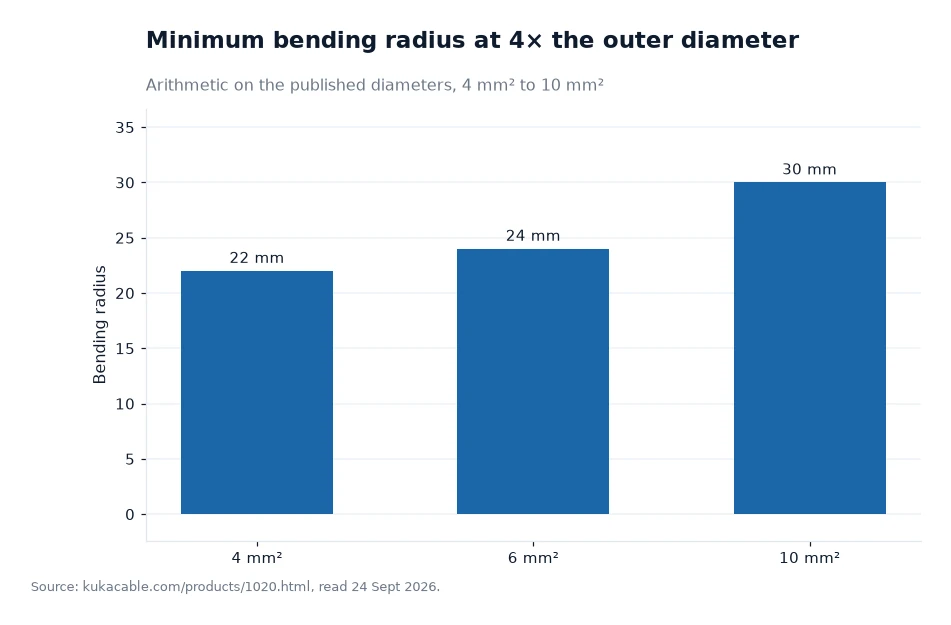
Then check the values that decide how the cable will be handled on site. Published diameters are 5.5 mm for 4 mm², 6.0 mm for 6 mm² and 7.5 mm for 10 mm², and the minimum bending radius is four times the outer diameter. My own arithmetic on those figures gives 22 mm, 24 mm and 30 mm respectively, assuming a single bend at room temperature with no tension on the cable.
Weight completes the trio. The same table lists 59 g per metre for 4 mm², 78 g for 6 mm² and 130 g for 10 mm², which my own multiplication turns into 5.9 kg, 7.8 kg and 13.0 kg for a 100 m length. Those figures cover the cable alone, so a packing list that adds a drum should come in above them rather than below.
What a sample can and cannot prove
A sample is a dimensional and tactile instrument. It shows whether the printed legend matches the description, whether the sheath is concentric around the cores, whether the colour is the one ordered, and whether a flexible conductor feels flexible in the hand rather than stiff and springy.
What a sample cannot do is age. Ultraviolet weathering, water resistance, tensile strength after ageing and flame behaviour all need time on a bench, and no piece of cable in a courier envelope will demonstrate any of them. Those claims live in the reports, which is why the sample and the documents are a pair rather than alternatives.
The manufacturer offers a free sample on its product pages, so there is no reason to accept a short offcut in a size you will not order. Ask for the cross-section, the colour and the core count that appear on your own specification, so the piece that arrives can be compared with the page it came from.
Certificates and test reports are not the same thing
A certificate names a standard and a scope for a product type, while a test report shows a result for a sample on a date. The certificates page counts more than 30 certificate types and names TUV, IEC, CE, SAA and UL among them, with the UL entry described as being in the process of updating. The standards named for the PV family itself are TUV 2PfG 1169/08.2007, EN 50618:2014 and IEC 62930, and two regional requirements are highlighted as well: a CPR fire rating and an AD8 waterproofing rating.
The test list covers the other half of the question. It names nine checks: water resistance, ultraviolet accelerated weathering, abrasion, cold bending, cold elongation, tensile strength after ageing, solderability, static flexibility and construction plus dimensional testing. The xenon lamp weathering test is arranged to run for 2,000 hours, which the client equates with about 360 weathering cycles.
Mechanical headroom is stated in the same place: elongation before ageing is required to be at least 125% by EN 50618, and the client states its PV cables typically reach up to 185%. A vertical flame test is described for a single cable at 800 °C for one minute, after which the cable is expected to self-extinguish.
The questions a website cannot answer
Price per metre, minimum order quantity, lead time and warranty terms are not published anywhere on the manufacturer's site. That is not an oversight to be read into; it means those four items can only arrive on a quotation, and a buyer should ask for each of them in writing rather than infer one from another.
The published footprint is a different kind of answer. The company page lists a warehouse in Blackley, Manchester, one in Logroño in La Rioja, Spain, an office and warehouse in Tangerang, Indonesia, and offices or warehouses in Queensland, Victoria, New South Wales, Western Australia and South Australia, with the head office at 9655 Tingwei Road in Shanghai. A buyer can ask which of those locations would serve a project without reading a delivery promise into the list.
Contact details are published on every page: telephone 0086-18317109559 and email [email protected]. A supplier that prints the same two channels everywhere is easy to test, because a question sent to one of them can be compared with the answer to the same question sent later to the other.
A vetting checklist in one table
The sequence below is my own working order, not something the manufacturer publishes. It starts with the document that can be checked against a measurement and ends with the commercial terms, which need a quotation before they can be compared at all.
| Step | What to request | Where the published values sit |
|---|---|---|
| 1. Size datasheet | The page for the exact cross-section | Product pages for the 1500 V solar cable and the cross-section table |
| 2. Dimensional sample | A free sample in the ordered size and colour | Sample offer on the product pages |
| 3. Certificate list | The certificates in force for that construction | Certificates page with more than 30 types named |
| 4. Test list | The named checks and the reports behind them | Laboratory test page with nine items |
| 5. Facility and reach | Where the product is made and where stock sits | Company page with the warehouse list |
| 6. Commercial terms | Price basis, quantity, lead time, warranty wording | Not published; quotation only |
Worked example: from a sample to an order line
Suppose the sample measures 6.0 mm across the sheath. The published diameter for 6 mm² is 6.0 mm, so the sample matches the size on the enquiry, and the bending radius that follows from the four times rule is 24 mm by my own calculation. That figure becomes a sentence in the installation instruction rather than a guess made on the roof.
Weigh the sample next. At 78 g per metre, a 100 m length comes to 7.8 kg by my own multiplication, so an order for 500 m should come back around 39 kg of cable before the drum is counted. If the quotation's packing list is far below that, the length or the size on the line deserves a second look.
The last check costs nothing: read the legend printed on the sheath and confirm it names the same standard the quotation cites. A sample that carries no print, or a print that names a different standard, is a discrepancy a buyer can raise before the purchase order rather than after the delivery.
Frequently asked questions
What should a buyer ask for before placing a first order?
Ask for four things: the datasheet of the exact cross-section, a free sample in that size and colour, the certificates in force for the construction, and the test reports behind the named checks. Then measure the sample against the published diameter table, which lists 5.5 mm for 4 mm², 6.0 mm for 6 mm² and 7.5 mm for 10 mm².
Is a certificate enough on its own?
No. A certificate names a standard and a scope, while a test report shows a measured result for a sample. The manufacturer's certificate list counts more than 30 types, with TUV, IEC, CE, SAA and UL named and the UL entry described as being updated, and its test page names nine checks including water resistance, ultraviolet weathering, abrasion and tensile strength after ageing.
What to do with the answers
Put the datasheet values beside the sample, the certificate beside the specification, and the test list beside the installation conditions. Anything that cannot be matched that way becomes a written question, and a written question is the only thing a supplier can answer precisely.
The manufacturer also publishes a catalogue, downloadable data sheets and a description of its one-stop butler service, in which a product consultant follows an enquiry from specification through to delivery and after-sales maintenance. Prices, minimum quantities and lead times are not published on the site, so a first order still ends with a quotation and a purchase order rather than with a web form.
Every figure in this supplier-vetting article traces to the manufacturer's own website; the bending-radius table was retrieved 24 Sept 2026[1].