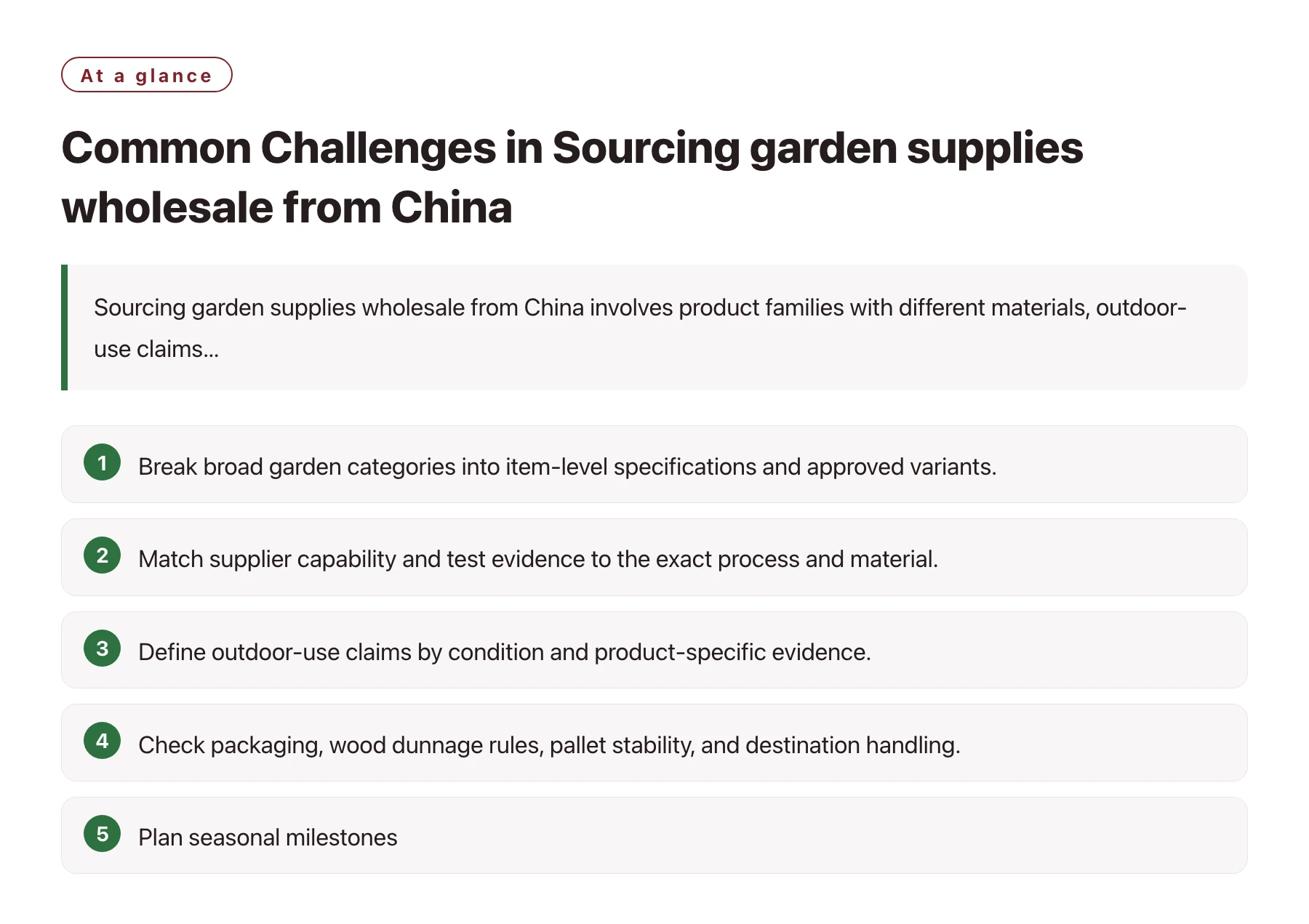
Sourcing garden supplies wholesale from China involves product families with different materials, outdoor-use claims, packaging needs, and seasonal schedules. Buyers should specify each item, verify the supplier’s process capability, require evidence for performance claims, plan cartons and pallets for the route, and compare quotes against the same landed responsibilities.
Key takeaways
- Break broad garden categories into item-level specifications and approved variants.
- Match supplier capability and test evidence to the exact process and material.
- Define outdoor-use claims by condition and product-specific evidence.
- Check packaging, wood dunnage rules, pallet stability, and destination handling.
- Plan seasonal milestones, partial shipments, and landed-cost responsibility.
A wholesale assortment can combine many product types, but each item still needs an identifiable specification, supplier, package, and acceptance record.
Challenge: a broad product category hides different specifications
Garden supplies can include planters, hand tools, irrigation components, outdoor furniture, storage, lighting, soil products, and seasonal décor. A wholesale inquiry that lists only category names can produce offers that differ in material, dimensions, finish, accessories, and intended use. Build a line-item specification for each product family before comparing factories.
For each item, identify material and grade, size, color, finish, packaging, branding, assembly, quantity, and destination. State whether the product is intended for indoor storage, outdoor exposure, food growing, water contact, or another specific use. Ask suppliers to identify alternatives and exceptions separately from the requested product.
Use photographs and drawings as aids, not substitutes for measurable requirements. Record the source and revision of artwork, logos, and samples. If a product needs seasonal packaging or retail-ready cartons, include that requirement in the quote request rather than adding it after production is scheduled.
Challenge: supplier capability varies by process and material
A supplier experienced with plastic planters may not control metal fabrication, wood finishing, pumps, electronics, or woven materials. Ask which processes are performed at the named site and which are subcontracted. Identify the legal seller, manufacturer, export entity, and payment beneficiary if they differ, then record who owns product records and change notifications.
Request evidence specific to the product: material data, process flow, relevant capacity, production samples, inspection procedures, and examples of traceability. Verify that any certificate or test report covers the actual facility, material, and model. A broad factory profile does not establish capability for every item in a garden assortment.
If a wholesale program relies on multiple suppliers, map common components and packaging partners. Decide which items can be consolidated, which need separate inspections, and who will coordinate shade, finish, accessory, and delivery interfaces. A shared assortment plan can expose dependencies before the purchase orders are released.
Challenge: outdoor-use claims need defined evidence
Words such as weather-resistant, rustproof, UV-stable, heavy-duty, or frost-safe need a stated use condition and evidence. Ask the supplier what test or material specification supports the claim, the duration or environment represented, and the product variants covered. Do not infer outdoor performance from a promotional image or a sample viewed indoors.
For exposed metal, plastics, textiles, coatings, wood, and seals, identify the characteristics that matter to the buyer: corrosion behavior, color retention, dimensional stability, water drainage, fastener integrity, or cleaning method. Select tests or inspection criteria with a qualified reviewer and document limits. Claims must match the product and market, not a different material option.
Approve samples under comparable conditions. Record production source, color, finish, material, and any special preparation. Where a product will be sold under multiple labels or in several colors, decide whether one sample represents the full range or each variant needs review.
Challenge: packaging creates damage or import problems
Garden goods vary in shape, weight, and sensitivity to moisture or abrasion. Specify carton strength, inner protection, stacking limit, pallet pattern, ventilation where needed, and labels for fragile or oversized items. Check that packaged units fit warehouse equipment and destination storage. Retail packaging, master cartons, and transport packaging should have distinct requirements.
If raw wood pallets, crates, or dunnage are used, check the destination country’s rules. The International Plant Protection Convention’s ISPM 15 standard addresses phytosanitary measures for wood packaging material in international trade and includes dunnage.[1] Confirm current requirements with the importer or broker and require compliant packaging evidence where applicable; the rule does not apply identically to every packaging material or destination.
Ask suppliers to provide final carton dimensions, gross weight, pallet count, and loading photographs. Reconcile those values with the booking and packing list before dispatch. If several product types share a container, protect heavier items from crushing lighter cartons and retain separate item and lot identifiers.
Challenge: seasonal demand compresses decisions
Garden products may be ordered against a sales season, planting period, or retail reset. Work backward from required receipt and include sample approval, artwork, production, inspection, cargo-ready, transit, customs review, and warehouse processing. State which dates are estimates and what event starts the supplier’s lead-time commitment.
Confirm the order’s minimums, component availability, color mix, carton quantities, and capacity before the peak period. If an item depends on imported materials or a subcontracted process, identify the risk and possible alternatives early. Avoid releasing a forecast as a firm order without stating which quantities and options are authorized.
Plan whether the shipment can arrive in stages. Partial orders may protect a launch date but add freight, handling, and inventory complexity. Set a decision owner for split shipments and record how remaining quantities, package labels, and invoices will be controlled.
Challenge: wholesale quotations omit landed responsibilities
Normalize quotations for unit, quantity, currency, validity, tooling, packaging, inspection, export handling, delivery term, named place, and exclusions. Compare total cost for the same product and shipment assumptions. Ask each supplier to identify what is not included, such as testing, retail cartons, pallet treatment, consolidation, or destination charges.
Clarify who books freight, handles export documents, coordinates customs brokerage, and arranges inland delivery. Match those roles to the purchase contract and named delivery point. If the buyer uses its own forwarder, confirm who provides cargo-ready information and who pays storage or delay charges if the booking changes.
For garden supply wholesale sourcing in China, buyers may assess garden supply wholesale from China as one procurement resource. Confirm the current categories and service scope, and keep product specifications, market requirements, and final acceptance with the designated buyer owners.
Sources
Frequently asked questions
What details should be included in a garden supply quote request?
List product, material, dimensions, finish, variants, accessories, packaging, branding, quantity, destination, schedule, and required evidence. Ask suppliers to show deviations separately.
How should outdoor-use claims be checked?
Ask for the test method, conditions, result, model coverage, and limitations. Review evidence against the intended environment with a qualified product owner.
Do all garden shipments need ISPM 15 wood packaging?
Requirements depend on destination and packaging material. Confirm current rules with the importer or broker when pallets, crates, or dunnage use regulated wood packaging.
How can seasonal lead times be made more reliable?
Work backward from receipt, confirm material and capacity assumptions, define the lead-time trigger, and assign owners for samples, artwork, inspection, booking, and any split shipment.